
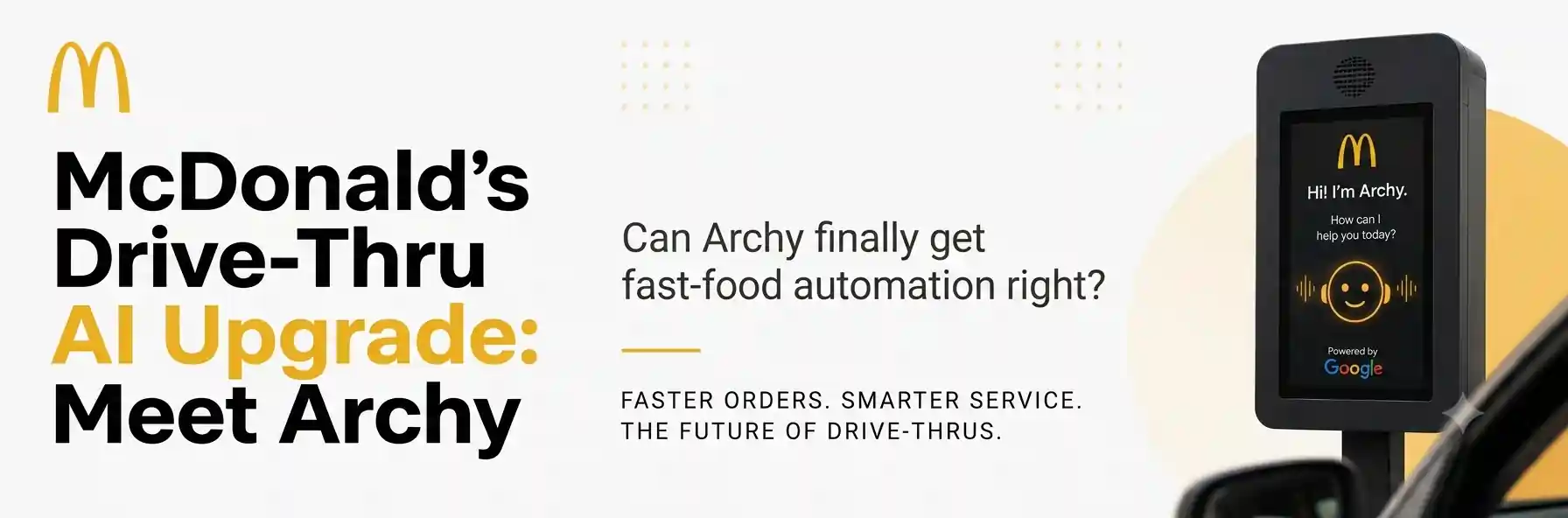
McDonald’s is bringing artificial intelligence back to the drive-thru with a new Google-backed ordering system called ArchIQ (Archy). After previous AI experiments struggled with accuracy issues, the fast-food giant is hoping its latest technology can deliver faster service, improved order accuracy, and a better customer experience.
Quick Answer
McDonald’s new AI drive-thru system, known as Archy, is a Google-backed voice ordering platform currently being tested in selected locations. According to reported figures, the system has already processed over 1 million orders, with approximately 90% completed without human intervention. The initiative is part of McDonald’s broader technology strategy aimed at improving speed and efficiency in drive-thru operations.
Table of Contents
McDonald’s Is Giving AI Another Chance
Artificial intelligence continues to reshape industries worldwide, and fast food is no exception. McDonald’s latest technology initiative introduces ArchIQ, commonly called Archy, a voice-based AI ordering assistant designed specifically for drive-thru operations.
The rollout begins with five restaurant locations and forms part of the company’s larger technology modernization strategy known as “> NEXT.”
Unlike traditional drive-thru systems that rely heavily on employees taking orders, Archy aims to automate much of the ordering process through conversational AI technology.
“The goal isn’t to create a clever AI assistant. The goal is to create a faster, smoother, and more reliable drive-thru experience.”
What Is Archy?
ArchIQ (Archy) is McDonald’s latest AI-powered voice ordering system. Designed to interact with customers naturally, the platform listens to orders, processes requests, and communicates directly through the drive-thru speaker system.
The technology seeks to reduce employee workload while maintaining speed and accuracy during busy service hours.
| Feature | Purpose |
|---|---|
| Voice Recognition | Understands customer orders |
| Automated Ordering | Reduces human intervention |
| Drive-Thru Integration | Works directly with ordering lanes |
| AI Processing | Handles customer requests in real time |
Why Fast-Food Chains Are Investing in AI Drive-Thrus
On paper, drive-thru ordering appears to be an ideal use case for artificial intelligence.
- Menus are structured and predictable.
- Orders follow common patterns.
- Conversations are generally short.
- Businesses want faster service times.
- Labor efficiency remains a major priority.
For restaurant operators, AI promises several potential benefits:
- Reduced wait times
- Improved operational efficiency
- Consistent customer interactions
- Lower staffing pressure
- Scalable technology deployment
The Challenge: McDonald’s Has Been Here Before
While the new rollout sounds promising, McDonald’s previous AI ordering experiment remains a significant factor in public perception.
The company previously tested an IBM-backed AI ordering system that gained attention for mistakes made during customer interactions.
Those errors quickly spread across social media platforms, turning isolated ordering issues into viral moments that raised questions about whether voice AI was ready for large-scale deployment.
Early Results From the New Archy System
According to reported information from a franchisee, Archy has already processed more than 1 million orders.
Perhaps more importantly, approximately 90% of those orders reportedly required no human intervention.
| Reported Metric | Result |
|---|---|
| Orders Processed | 1 Million+ |
| Human-Free Orders | Approximately 90% |
| Initial Locations | 5 Restaurants |
Why Drive-Thru AI Is More Difficult Than It Looks
Many people assume ordering food is a simple task for AI systems. In reality, drive-thru environments present unique challenges.
Common Challenges Include:
- Customers speaking unclearly.
- Background traffic noise.
- Children talking inside vehicles.
- Last-minute order changes.
- Complex menu customizations.
- Regional accents and speech patterns.
- Requests for app-exclusive items.
A voice AI system must understand these variables while maintaining accuracy and speed. Even a small misunderstanding can result in incorrect orders, frustrated customers, and slower service times.