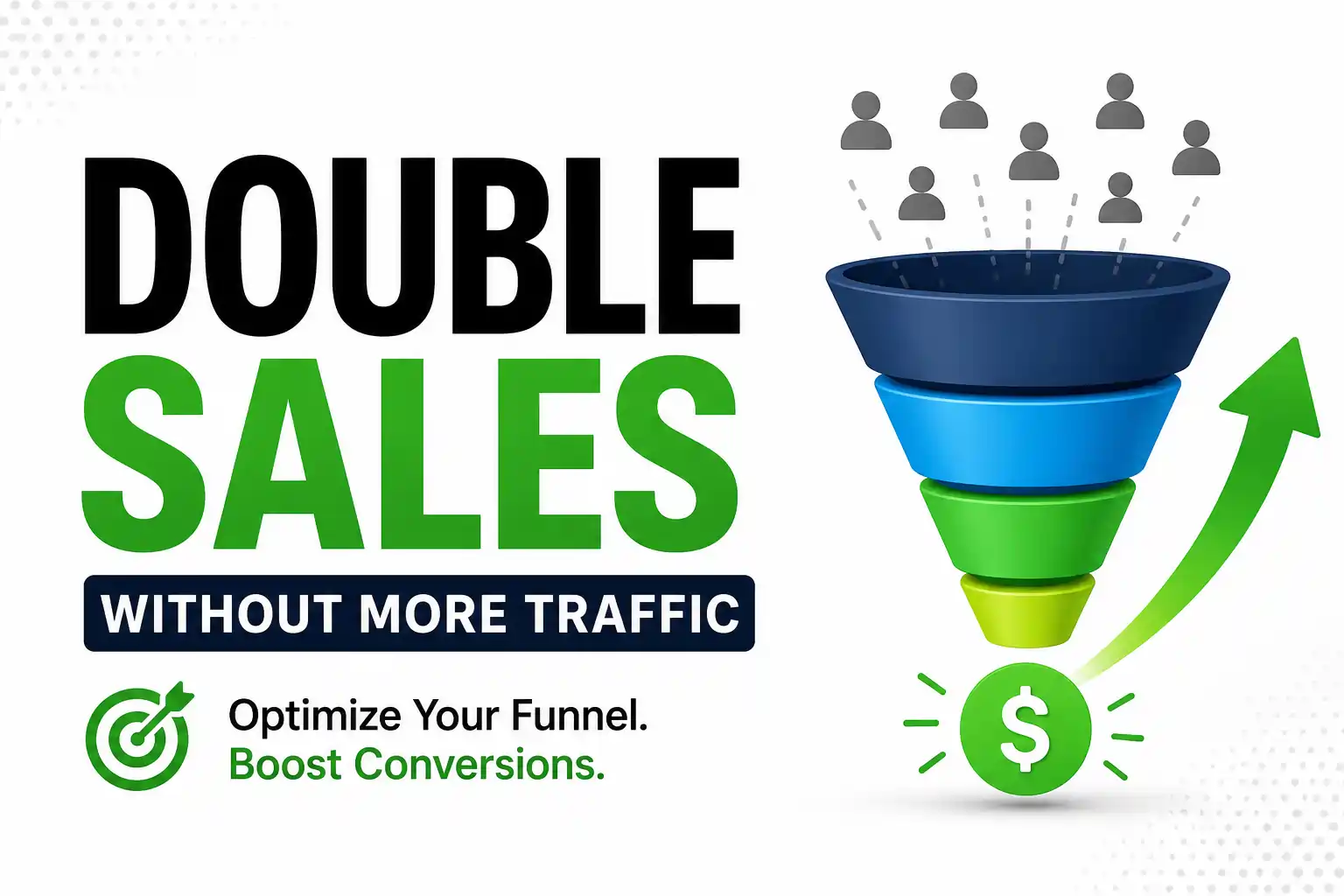
Imagine getting twice as many customers without increasing your advertising budget or attracting more website visitors.
While many businesses focus on driving more traffic, the real opportunity often lies in improving how existing visitors move through the buying journey. Every day, potential customers leave websites because of confusing navigation, slow loading pages, weak calls-to-action, or complicated checkout processes. These small friction points can significantly reduce your conversion rate.
This is where conversion funnel optimization makes a difference.
Instead of spending more money to bring in new visitors, conversion funnel optimization helps you improve every stage of your sales funnel—from the first interaction to the final purchase. By identifying where users drop off and making targeted improvements, you can convert more visitors into paying customers and maximize the return on your existing traffic.
In this guide, you’ll learn:
- What conversion funnel optimization is
- Why more traffic doesn’t always increase sales
- The stages of a high-converting sales funnel
- Proven strategies to improve conversions
- Common mistakes that hurt your funnel
- The best tools to analyze and optimize your funnel
Whether you run an ecommerce store, SaaS platform, or service-based business, these strategies can help you generate more revenue without increasing your marketing spend.
What Is Conversion Funnel Optimization?
Conversion funnel optimization is the process of improving every stage of the customer journey to increase the percentage of visitors who become paying customers. It focuses on removing friction, improving user experience, and testing changes that encourage more users to complete desired actions such as making a purchase, signing up, or requesting a quote.
Why this matters: Instead of chasing more traffic, you improve the performance of the traffic you already have.
Example
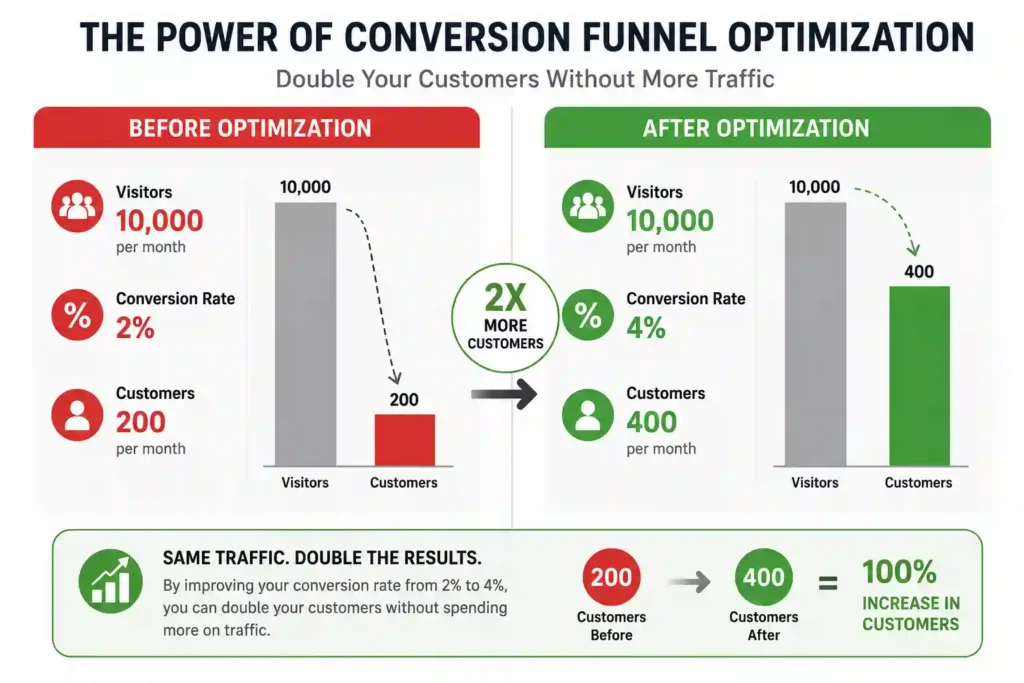
Imagine your website receives 10,000 visitors every month.
- Conversion rate: 2%
- Customers: 200
After optimizing your conversion funnel:
- Same traffic: 10,000 visitors
- Conversion rate: 4%
- Customers: 400
Without spending another dollar on advertising, you’ve doubled your sales simply by improving your conversion funnel.
Why Conversion Funnel Optimization Matters
Many businesses assume that more traffic automatically leads to more sales. In reality, traffic alone doesn’t generate revenue conversions do.
If your website has a poor user experience or an inefficient sales funnel, increasing traffic only sends more people into a process that isn’t working well.
Here are some common reasons visitors leave before converting:
- Slow-loading pages
- Confusing navigation
- Weak or unclear calls-to-action
- Lengthy forms
- Complicated checkout processes
- Lack of trust signals
- Poor mobile experience
Each issue creates friction that discourages users from taking the next step.
By optimizing these touchpoints, you can improve your conversion rate, lower customer acquisition costs, and increase revenue without relying solely on paid advertising.
What Is a Conversion Funnel?
A conversion funnel is the journey a visitor takes before becoming a customer. It represents each stage of the buying process, from discovering your brand to completing a purchase and becoming a loyal customer.
The term “funnel” is used because the number of people decreases at each stage. Many visitors enter the funnel, but only a percentage complete the desired action.
Understanding this journey helps businesses identify where potential customers drop off and make improvements that increase conversions.
Quick Answer:
A conversion funnel is a step-by-step path that guides visitors from their first interaction with your business to becoming paying customers. Optimizing each stage of the funnel reduces drop-offs and increases your overall conversion rate.
The 5 Stages of a Conversion Funnel
Every successful sales funnel consists of five key stages. Each stage plays a different role in moving users closer to making a purchase.
1. Awareness
This is where potential customers first discover your business.
They may find your website through:
- Google Search
- Social media
- Paid advertisements
- Blog articles
- YouTube videos
- Referrals
- Email campaigns
At this stage, users aren’t necessarily ready to buy. They’re looking for information, answers, or solutions to a problem.
Goal: Capture attention and make a strong first impression.
Example:
A business owner searches for “how to increase ecommerce sales” and lands on your blog about conversion funnel optimization.
2. Interest
Once visitors know about your brand, they begin exploring your products or services.
During this stage, they might:
- Read blog posts
- Browse product pages
- Watch demo videos
- Download resources
- Compare features
- Read customer reviews
Your content should educate visitors and build trust without being overly promotional.
Goal: Keep visitors engaged and encourage them to learn more.
3. Consideration
Now the visitor is comparing different options before making a decision.
They’re asking questions like:
- Is this the right solution?
- Can I trust this company?
- Is it worth the price?
- What makes it better than competitors?
This is where trust becomes critical.
You can increase confidence by including:
- Customer testimonials
- Case studies
- Success stories
- Product demonstrations
- Certifications
- Money-back guarantees
- Transparent pricing
Goal: Remove doubts and position your business as the best choice.
4. Conversion
This is the most important stage of the funnel.
The visitor finally completes your desired action, such as:
- Purchasing a product
- Booking a consultation
- Starting a free trial
- Subscribing to a service
- Requesting a quote
- Filling out a contact form
Unfortunately, many businesses lose customers here because of unnecessary friction.
Common conversion blockers include:
- Long checkout forms
- Hidden fees
- Slow payment pages
- Complicated navigation
- Mandatory account creation
- Limited payment options
Even small improvements at this stage can significantly increase your sales.
Goal: Make completing the action as fast and effortless as possible.
5. Retention
A conversion doesn’t end the customer journey—it begins a new one.
Returning customers often spend more, purchase more frequently, and recommend your business to others.
You can improve customer retention by:
- Sending personalized emails
- Offering loyalty rewards
- Providing excellent customer support
- Recommending related products
- Sharing helpful content
- Asking for feedback
Acquiring a new customer usually costs more than retaining an existing one, making retention a valuable long-term growth strategy.
Goal: Turn one-time buyers into loyal customers and brand advocates.
How a Conversion Funnel Works
Here’s a simple example of how visitors move through a typical funnel:
| Funnel Stage | Visitors | Action |
|---|---|---|
| Awareness | 10,000 | Visit your website |
| Interest | 6,500 | Read content or browse products |
| Consideration | 2,500 | Compare products or pricing |
| Conversion | 250 | Make a purchase |
| Retention | 80 | Return for another purchase |
This example shows that losing visitors at each stage is normal. The goal of conversion funnel optimization is not to eliminate drop-offs entirely but to reduce unnecessary friction so that more people progress through the funnel.
Why Funnel Drop-Offs Matter
Many businesses focus on attracting more traffic, but they overlook the reasons visitors leave before converting.
Common causes of drop-offs include:
- Slow page load times
- Poor mobile experience
- Confusing navigation
- Weak calls-to-action (CTAs)
- Lack of trust signals
- Complicated checkout process
- Unclear pricing
- Irrelevant or low-quality content
Each issue creates friction that makes visitors less likely to complete the desired action.
Conclusion
Growing your business isn’t always about attracting more visitors—it’s about making the most of the traffic you already have. By focusing on conversion funnel optimization, you can identify where potential customers drop off, remove friction, and create a smoother path to conversion.
Small improvements, such as faster page load times, clearer calls-to-action, a simplified checkout process, and stronger trust signals, can have a significant impact on your conversion rate. Over time, these incremental changes compound, helping you generate more leads, increase sales, and improve your return on investment without increasing your marketing budget.
Remember, a high-performing conversion funnel is never truly finished. Customer behavior, market trends, and user expectations continue to evolve, so regularly analyzing your funnel, testing new ideas, and refining the user experience are essential for long-term growth.
Instead of asking, “How can I get more traffic?”, start asking, “How can I convert more of the traffic I already have?” That shift in mindset is often the difference between stagnant growth and a business that consistently increases revenue.
If you haven’t evaluated your sales funnel recently, now is the perfect time to audit every stage of the customer journey. Even one improvement could lead to more conversions, happier customers, and sustainable business growth.
Frequently Asked Questions
What is conversion funnel optimization?
Conversion funnel optimization is the process of improving each stage of the customer journey to increase the percentage of visitors who complete a desired action, such as making a purchase, signing up for a service, or requesting a quote.
Why is conversion funnel optimization important?
It helps businesses generate more sales and leads from their existing website traffic, reducing customer acquisition costs and improving overall marketing ROI.
What is a good conversion rate?
A good conversion rate varies by industry, but many websites achieve between 2% and 5%. High-performing businesses often exceed this by continuously testing and optimizing their conversion funnels.
How do I optimize my conversion funnel?
Start by analyzing user behavior, identifying drop-off points, improving page speed, simplifying forms, strengthening calls-to-action, adding trust signals, and running A/B tests to measure results.
What’s the difference between conversion rate optimization (CRO) and conversion funnel optimization?
Conversion rate optimization (CRO) focuses on increasing the percentage of visitors who complete a desired action, while conversion funnel optimization looks at the entire customer journey, improving every stage of the funnel to reduce friction and increase conversions.