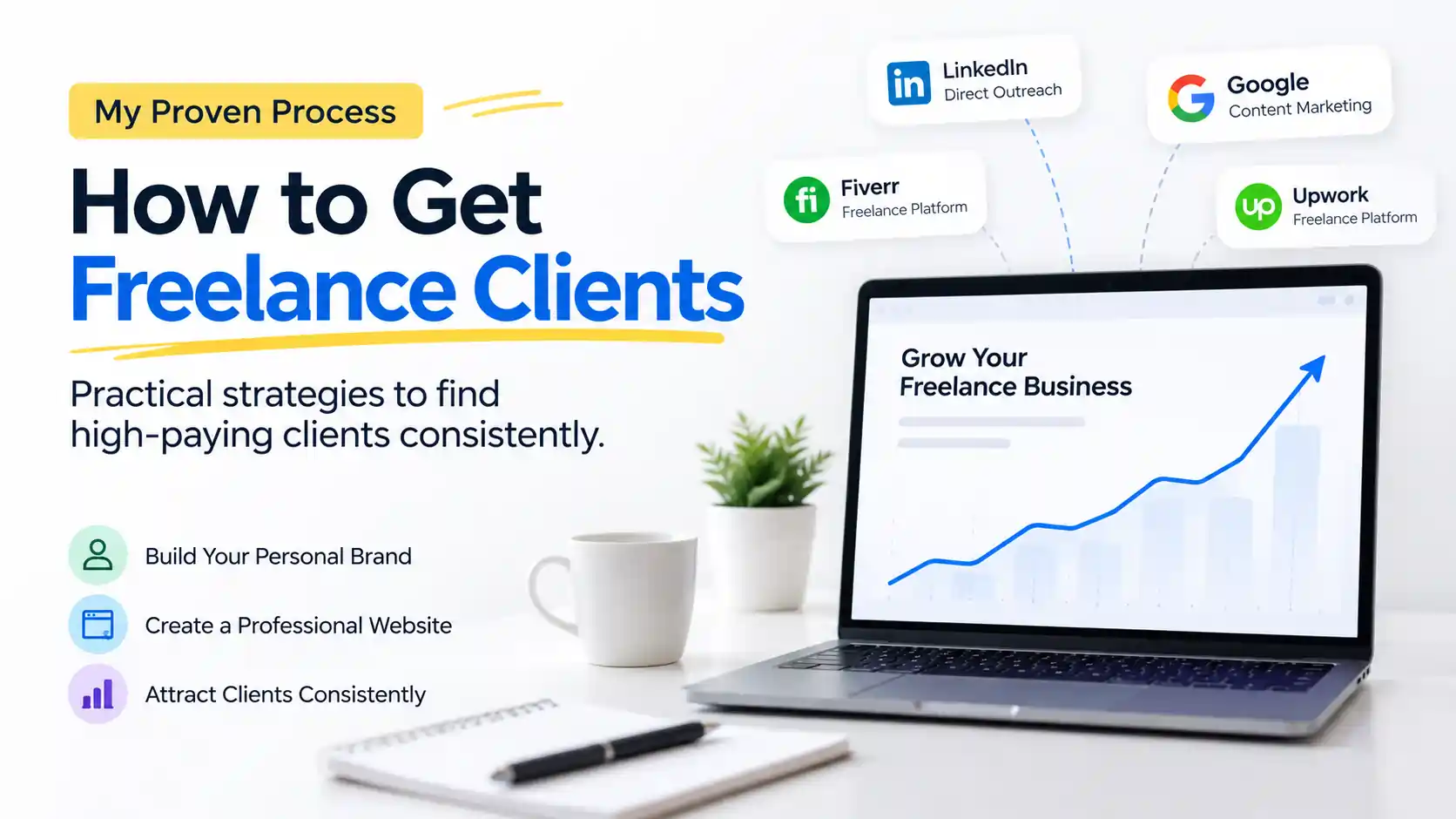
Stop waiting for clients to find you. Build a system that brings them to you.
Getting freelance clients is one of the biggest challenges every freelancer faces. Whether you’re a web developer, graphic designer, SEO specialist, copywriter, or digital marketer, one question always comes up:
“Where do I find clients?”
When I first started freelancing, I believed creating profiles on Fiverr, Upwork, and Freelancer would be enough. I spent hours optimizing my profile, writing service descriptions, and waiting for notifications.
Unfortunately, nothing happened.
Days turned into weeks, and weeks turned into months. I realized that simply joining freelance platforms doesn’t guarantee success. Thousands of talented freelancers are competing for the same opportunities, and many of them have years of experience and hundreds of positive reviews.
Instead of blaming the platforms, I decided to change my strategy.
Rather than depending on one marketplace, I started building my personal brand across multiple platforms. I created a professional website, published helpful blog posts, stayed active on social media, optimized my freelance profiles, and reached out to potential clients directly.
As a result, I stopped relying on a single source of leads.
Today, my projects come from different channels. Sometimes a client discovers one of my blog posts through Google. Other times, they find my LinkedIn profile, browse my portfolio, and send me a message. In many cases, visitors land on my website first and later place an order through Fiverr because they feel more comfortable using the platform.
This approach has completely changed my freelancing career.
In this guide, I’ll explain the exact process I use to find freelance clients consistently. More importantly, you’ll learn how to build a system that continues generating opportunities—even while you sleep.
Why Most Freelancers Never Get Enough Clients
One of the biggest mistakes freelancers make is relying entirely on freelance marketplaces.
They create an account on Fiverr or Upwork, publish a few services, and then wait for clients to contact them.
Unfortunately, that’s not how freelancing works anymore.
Every day, thousands of new freelancers join these platforms. Consequently, competition becomes stronger, making it harder for beginners to get noticed. Even highly skilled professionals struggle if they depend on only one source of traffic.
Think about it this way.
Imagine opening a restaurant in the middle of a busy city but refusing to advertise it anywhere. Even if your food is excellent, very few people will know your restaurant exists.
The same principle applies to freelancing.
Your skills might be exceptional. However, clients can’t hire you if they don’t know you exist.
That’s why successful freelancers focus on visibility before expecting sales.
Instead of asking:
“How do I get more orders?”
Ask yourself:
“How can more people discover my work?”
That simple mindset shift changes everything.
The Mindset Shift That Changed My Freelancing Career
After months of waiting for projects, I realized something important.
Freelancing isn’t just about delivering services—it’s about marketing yourself.
Many freelancers think they’re competing with other freelancers.
In reality, they’re competing for attention.
Clients receive hundreds of proposals every week. Therefore, your goal isn’t simply to be better than everyone else. Your goal is to become visible in the places where clients are already searching.
Once I understood this, I stopped treating Fiverr and Upwork as my entire business.
Instead, I treated them as one part of a much bigger marketing system.
That decision completely changed my approach.
Rather than asking whether Fiverr would bring me clients, I started asking how I could send more qualified visitors to my Fiverr profile.
Similarly, I stopped expecting LinkedIn to generate instant projects. Instead, I used it to build relationships with decision-makers who might need my services later.
Little by little, every platform started supporting the others.
My Freelance Client Acquisition System
Today, I don’t rely on a single platform to generate income.
Instead, I have built a simple ecosystem where every platform works together.
My system includes:
- A professional website
- Fiverr
- Upwork
- Freelancer.com
- Business WhatsApp
- Business Email
At first glance, this may look like a lot of work. However, each platform has a specific purpose.
For example:
- My website builds trust.
- Google brings organic visitors through blog content.
- LinkedIn helps me connect with business owners and decision-makers.
- Fiverr provides secure purchasing options for clients who prefer marketplace protection.
- Social media keeps my brand active and visible.
Because every platform supports the others, I never depend on one source of traffic.
That’s exactly how a real business operates.
Step 1: Build a Personal Brand, Not Just Freelance Profiles
Most freelancers spend all their time optimizing Fiverr gigs while completely ignoring their personal brand.
This is a huge mistake.
Imagine two freelancers offering the same service.
The first freelancer only has a Fiverr profile.
The second freelancer has:
- A professional website
- LinkedIn profile
- Active social media
- Helpful blog articles
- Business email
- Business WhatsApp
- Portfolio
- Client testimonials
Who appears more trustworthy?
The answer is obvious.
People don’t just buy services.
They buy confidence.
That’s why I made sure every platform represented the same professional identity.
Keep Everything Consistent
Consistency builds trust.
Therefore, I use the same:
- Business name
- Logo
- Profile picture
- Email address
- Phone number
- WhatsApp Business account
- Service descriptions
- Portfolio
As a result, clients immediately recognize my brand, regardless of where they find me.
For example, someone might discover my website through Google today. A few days later, they may come across my LinkedIn profile or Fiverr account.
Since everything looks consistent, they feel confident they’re dealing with the same professional business.
That consistency increases credibility before I even speak with them.
Step 2: Build a Website That Works for You 24/7
If freelance platforms are your storefronts, your website is your headquarters.
Everything eventually points back to it.
Many freelancers believe they don’t need a website because they already have Fiverr or Upwork profiles.
I used to think the same way.
However, I quickly realized that freelance marketplaces only allow limited customization. Your website, on the other hand, gives you complete control over how you present your business.
That’s why I invested time in creating a professional website.
Instead of acting like an online business card, it works as a complete marketing platform.
Visitors can:
- Learn about my services.
- Browse my portfolio.
- Read detailed case studies.
- Explore my blog.
- Contact me through WhatsApp.
- Send an email.
- Visit my Fiverr or Upwork profiles.
In other words, my website answers almost every question before a client contacts me.
A Small Detail That Makes a Big Difference
One feature I particularly like is how I display my freelance profiles.
Instead of placing plain text links, I designed custom cards that match the branding of Fiverr, Upwork, and Freelancer.com.
When visitors recognize these familiar platforms, they’re naturally encouraged to click.
Many clients visit my Fiverr profile after exploring my website.
By that point, they’ve already seen my portfolio, read my content, and learned about my experience.
Consequently, they’re much more likely to place an order.
That’s far more effective than expecting strangers to discover my Fiverr profile without any context.
Step 3: Let Content Bring Clients to You
Content marketing has become one of the most valuable parts of my client acquisition strategy.
Rather than constantly promoting my services, I focus on solving problems.
Every blog post answers a question that business owners are already searching for.
For example, I write about topics like:
- How to grow a business online
- How to increase website traffic
- Ways to generate more leads
- SEO strategies
- Website optimization
- Digital marketing tips
- Improving online sales
Instead of pushing people toward my services, I help them first.
As a result, trust develops naturally.
Here’s How It Works
Imagine a business owner searches Google for:
“How to increase sales from a website.”
They discover one of my articles.
The guide solves their problem and provides actionable advice.
While reading, they notice I also offer website development and SEO services.
Now they aren’t hiring a stranger.
They’re hiring someone who has already demonstrated expertise.
That’s the real power of content marketing.
Instead of chasing every client, your content starts attracting qualified prospects for you.
Why This Strategy Works Better Than Waiting for Orders
Many freelancers spend their entire day refreshing Fiverr dashboards and hoping for new orders.
I used to do exactly the same thing.
Today, my focus is completely different.
Instead of waiting for opportunities, I spend my time creating assets that continue working long after I’ve finished them.
For example, a single blog post can attract visitors for months or even years. Likewise, a well-optimized website continues building trust around the clock. Meanwhile, every new article creates another opportunity for potential clients to discover my business through Google.
That’s why I treat content as a long-term investment instead of a short-term marketing tactic.
The more valuable content you publish, the more opportunities you create for people to find your work.
Eventually, your marketing begins working even when you’re offline.
Step 4: Optimize Every Freelance Platform
Many freelancers create accounts on Fiverr, Upwork, and Freelancer only once. After that, they rarely update anything.
Unfortunately, that’s a missed opportunity.
Your profile is not something you create once and forget. Instead, it should evolve as your experience grows.
Whenever I complete a project, learn a new skill, or improve my portfolio, I update my profiles across every platform.
For example, I regularly improve:
- Gig titles
- Service descriptions
- Portfolio images
- Pricing
- FAQs
- Keywords
- Project galleries
As a result, my profiles stay relevant and competitive.
Learn From Your Competitors
One habit that has helped me tremendously is competitor research.
Instead of copying successful freelancers, I study them carefully.
I ask myself questions like:
- Which services are they offering?
- What keywords are they using?
- How do they structure their packages?
- What problems are they solving?
- How do they present their portfolio?
After gathering ideas, I create something better.
Sometimes that means writing a clearer description.
Other times, it means offering additional value or explaining my process in more detail.
The goal isn’t to imitate others.
The goal is to understand what clients are already searching for and present your services in the best possible way.
Step 5: Use LinkedIn Sales Navigator to Find Decision-Makers
This is one of the most effective strategies in my entire workflow.
Instead of waiting for companies to contact me, I identify businesses that are likely to need my services.
LinkedIn Sales Navigator makes this process much easier.
Using its filters, I build a targeted list of professionals such as:
- Business Owners
- Founders
- Marketing Managers
- Operations Managers
- Digital Marketing Directors
- CEOs of small businesses
These people are usually responsible for making business decisions.
Instead of sending hundreds of random messages, I focus on quality over quantity.
That simple change has significantly improved my response rate.
Don’t Sell Immediately
One mistake I see freelancers make repeatedly is sending sales messages like this:
Hi, I’m a web developer. I offer SEO, website design, and digital marketing. Let me know if you’re interested.
Messages like these rarely receive replies.
Why?
Because they focus on the freelancer instead of the client.
Instead, I try to understand the business first.
For example, I might visit their website and notice:
- Slow loading speed
- Poor SEO
- Outdated design
- Missing conversion elements
- Technical issues
Then I send a personalized message.
For example:
Hi Sarah,
I came across your website while researching businesses in your industry. I noticed a few areas that could improve your site’s visibility and user experience.
I recorded a few suggestions that might help increase your website traffic and conversions. If you’re interested, I’d be happy to share them with you.
Notice the difference.
I’m offering value first.
Only after building trust do I talk about my services.
People appreciate helpful advice far more than unsolicited sales pitches.
Step 6: Turn Your Website Into a Client Funnel
Many freelancers treat their website like an online brochure.
Mine works differently.
Every page has a purpose.
Every visitor has a clear path to follow.
For example, someone may discover one of my blog articles through Google.
While reading, they might notice:
- My portfolio
- Service pages
- Client testimonials
- Business email
- WhatsApp Business
- Fiverr profile
- LinkedIn profile
They choose whichever contact method feels most comfortable.
Some people contact me directly.
Others prefer ordering through Fiverr because they trust the platform’s payment protection.
Either way, I gain a client.
That’s why I don’t worry about where the conversion happens.
My goal is simply to make the journey as easy as possible.
Step 7: Let Every Platform Support the Others
One lesson completely changed how I think about freelancing.
No platform should work alone.
Everything should connect together.
Think of your online presence like a network instead of separate accounts.
For example:
Google Search → Blog Article → Website → Fiverr Profile → Order
Or:
LinkedIn → Portfolio → Contact Form → Discovery Call
Or:
Facebook Post → Website → Case Study → WhatsApp
Each platform strengthens the next step.
Because of this, I don’t depend entirely on Google, LinkedIn, or Fiverr.
Instead, every channel contributes to the overall system.
That’s exactly how successful businesses operate.
Step 8: Stay Active on Social Media
I’m active on LinkedIn, Facebook, and Instagram.
However, I don’t use these platforms to constantly advertise my services.
Instead, I share useful content.
For example, I post:
- Website tips
- SEO insights
- Business growth strategies
- Recent projects
- Industry updates
- Lessons learned while working with clients
This keeps my audience engaged.
More importantly, it reminds people that I’m consistently working in my field.
Over time, this builds familiarity.
People are far more likely to hire someone they recognize than someone they’ve never seen before.
My Daily Routine for Finding Freelance Clients
Many people think freelancers spend their day waiting for messages.
My routine looks very different.
Every day, I divide my time into three areas.
Morning
- Reply to client messages.
- Check project updates.
- Follow up with previous conversations.
Afternoon
- Write blog content.
- Improve my website.
- Update freelance profiles.
- Publish helpful content.
Evening
- Research potential clients on LinkedIn.
- Send personalized outreach messages.
- Connect with new business owners.
- Plan content for the next day.
This routine may seem simple.
However, consistency produces results that occasional effort never can.
Some days I don’t receive any replies.
Other days I receive multiple inquiries.
That’s perfectly normal.
Client acquisition is a long-term process, not a one-day event.
Common Mistakes Freelancers Should Avoid
Over the years, I’ve noticed several mistakes that hold freelancers back.
Fortunately, they’re easy to fix.
Depending on One Platform
Never build your entire business around Fiverr or Upwork.
Algorithms change.
Competition increases.
Having multiple traffic sources protects your business.
Ignoring Your Personal Brand
Clients don’t just buy services.
They buy trust.
A professional website, LinkedIn profile, and consistent branding help you build credibility long before the first conversation.
Sending Generic Proposals
People ignore copy-and-paste messages.
Instead, personalize every outreach message.
Mention something specific about the company and explain how you can help solve a real problem.
Not Creating Helpful Content
Content is one of the few marketing assets that keeps working long after you publish it.
A useful article can continue attracting visitors for years.
That’s why I treat every blog post as another opportunity to meet future clients.
Frequently Asked Questions
How do beginners get freelance clients?
Start by creating professional profiles, building a simple portfolio website, and publishing examples of your work. At the same time, reach out to potential clients through LinkedIn and other professional networks instead of waiting for opportunities to appear.
Is a website necessary for freelancers?
Yes.
A website helps you showcase your portfolio, explain your services, publish valuable content, and build trust with potential clients. Unlike freelance marketplaces, you have complete control over your website and brand.
Should I rely only on Fiverr or Upwork?
No.
Freelance platforms are excellent lead sources, but they shouldn’t be your only source of income. Building multiple traffic channels makes your business far more stable over the long term.
How long does it take to get freelance clients?
There’s no fixed timeline.
Some freelancers land a project within a few weeks, while others need several months.
The important thing is to stay consistent.
The more people who discover your work, the greater your chances of finding the right clients.
Final Thoughts
If there’s one lesson I’ve learned throughout my freelancing journey, it’s this:
Clients rarely come to freelancers who simply wait.
They come to freelancers who consistently build trust, provide value, and make themselves visible.
My strategy isn’t based on luck.
- It’s based on creating a complete system.
- Use freelance platforms to establish credibility.
- Use my website to educate and convert visitors.
- Publish helpful content that answers real business questions.
- Connect with decision-makers on LinkedIn.
Finally, I stay active across multiple channels so potential clients can find me wherever they’re searching.
None of these strategies work overnight.
However, together they create a business that doesn’t rely on a single platform or a single source of traffic.
Start with one improvement today.
Build your website.
Optimize your profiles.
Publish your first helpful article.
Reach out to one potential client.
Then repeat the process tomorrow.
Small actions performed consistently will always outperform waiting for the perfect opportunity.
Freelancing is more than completing projects.
It’s about building relationships, creating trust, and developing a system that continues bringing opportunities for years to come.






2 Comments
Emmanuel Bruno
July 25, 2026, at 4:59 amHi goodday to you sir,
I came across your profile on LinkedIn and i have to say this is one of the most valuable posts I’ve come across today. I read it from beginning to end, and I could relate to so much of it. I’m currently working on building my skills and professional profile, and I’m very interested in getting involved. I’d greatly appreciate any guidance on the next steps or how I can participate. Thank you for sharing this!
Growthovate
August 14, 2026, at 9:33 amThank you so much for your kind words and for taking the time to read the post. I’m glad you found it valuable and relatable.
I regularly update my website with new opportunities, resources, and useful information, so please stay connected with me and keep an eye on the updates.